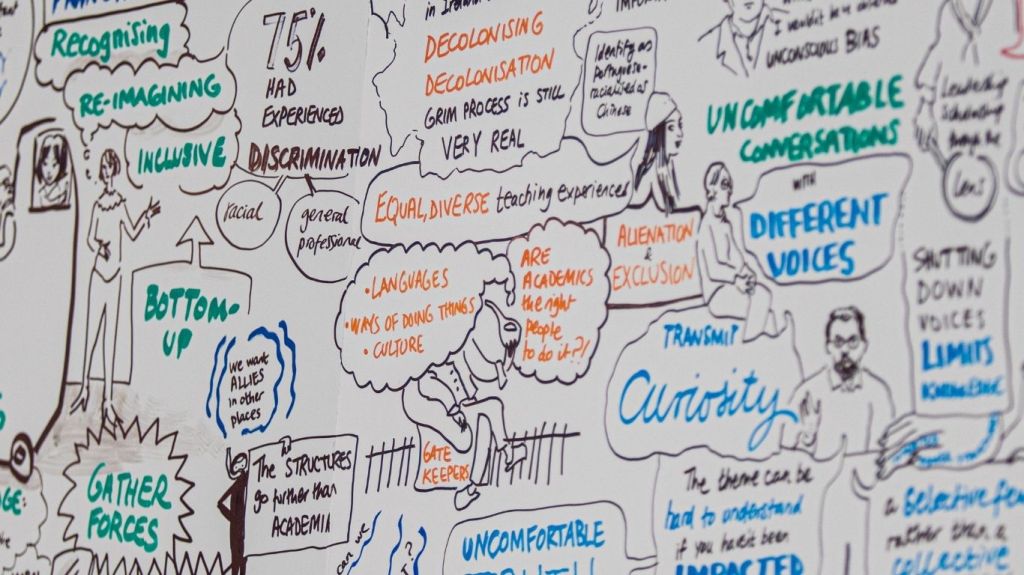
One of the first steps when thinking about decolonising the University and the Business School is to look at ways to decolonise our curriculum. Decolonising the curriculum is not about replacing one source with another, it’s about interrogating the current canon and the positionality of the key voices within it, looking at whose words are privileged and whose are missing. It’s about developing these critical literacy skills in students and finding ways for them to access previously unheard perspectives. When starting to decolonise the curriculum, it’s important to think about learning aims and objectives and why we might choose to include or omit certain content on courses.
“A largely white or largely male curriculum is not politically incorrect, as is often believed, but intellectually unsound.
Monocultures do not produce good thinking and are in themselves a lethal form of unmarked narrow identity politics.” (Gopal 2021, p877)
Decolonising is an ongoing process that occurs at many levels, and there’s also no “on-size-fits-all” process for decolonising. Below is taken from the article ‘How not to decolonise your curriculum’, and is a good place to start:
- Deconstructing ourselves. Who are we? Where do our roots lie? What privileges and disadvantages have we experienced in our own lives? Whose knowledge do we value? Whose perspectives have we ignored or dismissed? What do we fear?
- Deconstructing our subject discipline. What does the accepted canon of knowledge in our subject area look like? How has it varied over time and place? What’s missing? Might there be alternative canons? Is the very concept of an unchanging, “sacred” canon of knowledge becoming redundant in our subject area? Should our subject area even be a distinct discipline on its own? Are there different, more helpful ways of categorising knowledge?
- Deconstructing our institution. What does it stand for? Who is let in, and who is kept out? Who stays, and who drops out? Who achieves and who scrapes by? What assumptions are made about students’ prior cultural capital, expectations and potential? What assumptions are made about higher education traditions? Can these be broken down and re-interrogated? How might it be different? An example is what counts as valid knowledge – peer-reviewed journal articles only, or in a fast-changing world, can we teach our students to draw from a wider range of sources, applying their own critical analysis to what they find?
- Deconstructing our students. This is work that should be done with them rather than to them. Who are they? What’s important to them? What are their interests, goals, values and fears? What kind sense of entitlement do they have about being in higher education, or do they suffer from imposter syndrome, waiting to be found out? The Sewell reportLinks to an external site. talks of giving students a sense of “Britishness”, a shared heritage, in order to help them feel like they belong, but this feels to be in danger of producing the opposite effect and simply alienating them further. How about simply listening to what they have to say, and starting from where they’re at?
- Exploring our curriculum. When looking at the history of our subject can we find other sources of knowledge? How might our course content be reconceptualised in order to reflect wider global and historical perspectives? How might it be taught in a way that enables students to think for themselves and to evaluate and debate current cultural norms and traditions? How can we work with our students to help them shape their own educational experiences?
Reflecting on your curriculum & discussing the decolonisation of business studies with our students
These questions are taken from the Bayes Business School’s Manifesto for Decolonizing the Business School Curriculum. to decolonise your curriculum.
- What alternative models of enterprise based on economic cooperation can emerge from a decolonial imagination?
- In what ways is our current curriculum unrepresentative, inaccessible and/or privileged?
- How do we teach race, constructed through histories of colonialism and the transatlantic slave trade, in organization theory?
- What exclusions are apparent when we teach theories of leadership in organizational behaviour?
- In what ways are theories of organization gendered and racialised?
- How are histories of slavery intertwined with histories of capitalism?
- In what ways are modern ‘scientific’ management and accounting practices of labour productivity by-products of slavery?
- What colonial discourses inform our understanding of business ethics, stakeholder theory and corporate social responsibility?
- Whose voices are excluded and ways of knowing and being undermined in contemporary discourses of sustainability?
- How do we critically interrogate the notion of ‘inclusion’ in organisations?
- Where are the non-Western voices in management and organisation knowledge?
- What roles do UK business schools play in reinforcing colonial attitudes in the so-called postcolonial era?
- What neo-colonial formations underlie processes of globalisation and internationalisation?
- In what ways can decolonial insights create more equitable approaches to the governance of natural resource extraction and the governance of climate change?
- What are the implications for a decolonial understanding of supply chain management, stakeholder theory, business ethics, CSR, competitive strategy, leadership, organizational change, consumer behaviour, resource based view of the firm, valuation of nature, business ecosystems and other theories that inform our curriculum?
See also our ‘Decolonising the Curriculum framework’ which offers a flexible set of prompts to support colleagues in reflecting on, developing and extending their teaching practices in ways that are meaningful within their own disciplinary and institutional contexts. It is intended as a practical resource to guide ongoing experimentation and learning, rather than a prescriptive model or checklist.
References
- Priyamvada Gopal (2021) On Decolonisation and the University, Textual Practice, 35:6, 873-899.
 Decolonising a Business School