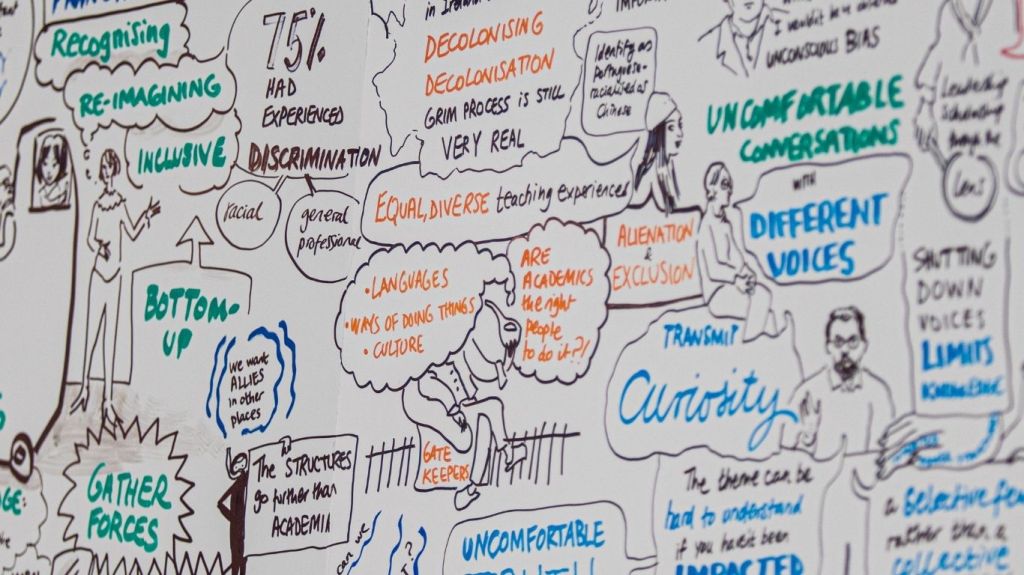
In a 2020 survey about attitudes to decolonisation from the Times Higher Education 71% of respondents agreed that “decolonisation of the curriculum is important in higher education”, 52 per cent of them strongly. Furthermore, those who described their race as other than white were even more likely to agree (81 per cent).
Decolonising education involves examining the limitations and biases of the current curricula; the omissions in initial teacher education and training; and examining the political and societal legacies of colonialism and how they have influenced education policies. In practice, decolonising education means rebuilding an education system that supports all students, staff and teachers, a system that is responsive to the particular needs of each and every child, pupil and student.
Read, watch, reflect.
This video was made by a student at the University of Birmingham. It explores the ‘decolonise the university’ movement, questioning ideas of who gets to have a voice within the institution.
The National Education Union defines a decolonised education as being made up of several important elements, although ostensibly referring to compulsory under 18 education, the principles are equally as applicable to higher education.
- A complete education: a broad and balanced education in which teaching fully examines British imperialism and racism, as well as histories and cultures from around the world.
- Understanding the history of inequalities: Colonisation’s many legacies shape the world we live in today. For example, domestic debates about migration would be completely different if they were informed by a shared understanding of Empire; the causes of the many inequalities that exist in Britain and globally would be better understood if the curriculum examined the philosophy behind, and impacts of colonisation, and the perspectives and rights of those who were colonised.
- A sense of belonging for Black people: Black teachers, lecturers and professors are not represented proportionately, especially in senior positions. Black students do not see themselves reflected and are not represented sufficiently in the curriculum or in teaching and learning resources. Additionally, Black students face high levels of racist bullying and stereotyping, and disproportionality in exclusions and some areas of attainment. Debates about Black students are often stereotypical and stigmatising, and Black communities are often viewed in deficit terms.
- Challenging racism: Colonisation was both predicated on, and has reinforced, racism. If all young people learnt about colonisation, we would have a better collective understanding of how race is constructed and used. This would mean we would all be better equipped to challenge racism more effectively.
It is also important to consider how colonial legacies are present within the University outside the curriculum too. How are the process and practices within the University continuing to maintain and conserve power imbalances? How are pedagogical and teaching methods favouring certain students over others? How are research practices maintaining colonial legacies and influencing what gets studied, and by whom?
Decolonisation involves a disruption for our disciplines and our teaching, but it shouldn’t be threatening. It should challenge us to make use of our critical thinking skills, gain better and more respectful understandings, and will help reset and rewrite some of the inherent prejudices and biases present in our society.
 Decolonising a Business School