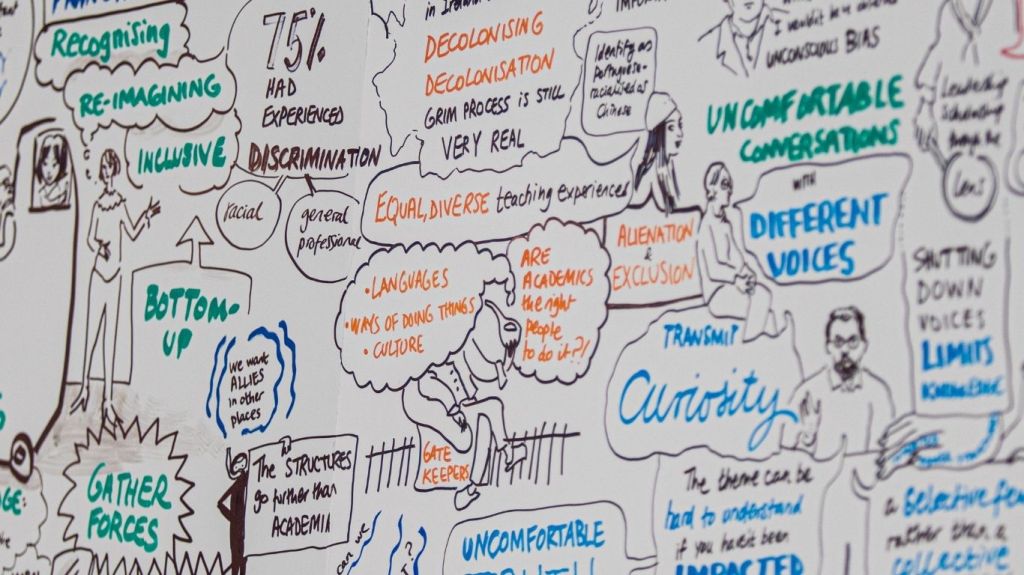
“The word itself ‘research’ is probably one of the dirtiest words in the indigenous world’s vocabulary” (Smith 2012, p1)
We only need to think back to the history of the university to begin to understand why some people may have this view, and how the connotations of ‘research’ can represent injustice, dehumanisation and oppression (watch this video Links to an external site.for more information). Decolonising research is a way to restore and reclaim control over the histories, lived experiences and ways of knowing of historically oppressed communities.
Positionality, power and (mis)representation are key in the process of decolonising research. By understanding our own position and power in relation to the social, political, economical, geographical context of the study we can begin to understand how this impacts our ways of seeing, our research process, and how we draw conclusions from what we find.
Decolonising research within the Business School
A central drawback of postcolonial scholarship in the business and management field is the overemphasis on theoretical critique, with little focus on methods. As such, there is a lack of insight on how to conduct first-hand research in this field (Western & Imas, 2018). As a starting point in this process, the discussion at a research symposium held at SOAS in 2017 on “Why decolonise Research methods” (Chiumbu, 2017) offers some interesting initial reflections as we embark on this journey. The book by Smith (2012) on Decolonising Methodologies also constitutes a helpful entry point. Other contributions from colleagues on their journeys with regards to the practice of decolonising the Ph.D. supervision process (Scobie, Lee and Smyth, 2021) or the research process (Yousfi, 2021) provide helpful inspirations as well.
Read, watch, reflect.
Questions to ask yourself about this topic are:
- Why do I need to decolonise research? What is the purpose?
- How can I centre reflexivity in research to avoid perpetuating ‘otherness’?
- How do I reflect upon my positionality, decision making and methodological choices to avoid harm, dehumanisation and violence in research?
A discussion board is here for your input on your thoughts and experiences in decolonising research practices. There is limited literature looking at this topic within the Business School environment, so thoughts, inputs and collaboration on this are welcome. Some areas to start with are:
- Re-emphasizing local, cultural and Indigenous forms of engagement (Tsui, 2004), engaging with performative methodologies to redistribute power (Denzin and Lincoln, 2008) and giving voice to the silenced (Muecke, 1992)
- There’s a need for highly reflexive, collaborative and participatory research methods within the various disciplines.
- The power of citation. What does your citation practice say about you and your discipline? How can we begin to make this fairer to those groups who are continually undercoated? See this blog for more information.
There are racial disparities in research grants and bids, reflected in the number of grants awarded to BME researchers in HE being much lower than to white applicants (UKRI).
- We need to ensure grant makers and awarding panels are diversified (where we can) to avoid selection biases.
- We need transparency in funding data of applications and success should be available to ensure institutions are holding themselves to account for meaningful and rational decision making.
- Grant makers and research funders need to be including bespoke systems of support to ensure those who are racialised are given the same opportunities when they are awarded a research grant.
References
- Chiumbu, S. (2017) ‘Why Decolonise Research Methods? Some Initial Thoughts’ HSRC Seminar, 2nd May, available online at: https://repository.hsrc.ac.za/bitstream/handle/20.500.11910/10905/9762.pdf?sequence=1&isAllowed=y
- Denzin, Norman K. & Lincoln, Yvonna S. (2008) ‘Introduction: Critical methodologies and indigenous inquiry’, in N.K. Denzin, Y.S. Lincoln & L.T. Smith (eds), Handbook of Critical and Indigenous Methodologies. Thousand Oaks, CA: Sage, pp. 1–20
- Muecke, Stephen (1992) Textual Spaces: Aboriginality and Cultural Studies. Sydney: New South Wales University Press
- Scobie, M., Lee, S. and Smyth, S. (2021) ‘Braiding together student and supervisor aspirations in a struggle to decolonise.’ Organization, 28(5): 857-875
- Smith, L. T. (2012). Decolonizing methodologies (2nd ed.). Zed Books.
- Yousfi, H. (2020) ‘Decolonising Arab organisational knowledge: “Fahlawa” as a Research Practice.’, Organization, 28(5): 836-856
- Tsui, Anne S. (2004) ‘Contributing to global management knowledge: A case for high quality indigenous research’, Asia Pacific Journal of Management, 21(4): 491–513.
 Decolonising a Business School