The decolonising the curriculum framework was developed to support colleagues who wanted to take meaningful action but were navigating different levels of confidence, experience and capacity.
Rather than offering a single model of “best practice”, the framework provides a flexible set of prompts and pathways that colleagues can adapt to their own disciplinary, pedagogical and institutional contexts. It is intended as a practical companion to reflection and experimentation, helping colleagues to identify entry points into decolonising.
At the same time, the framework recognises that decolonising teaching unfolds unevenly, requires time, and will look different across subjects, roles and experiences. It positions decolonisation as an ongoing process of learning, unlearning and adaptation, rather than a finite task, endpoint or checklist.
For more information, look at our introductory modules where there are pages on decolonising teaching practices.
Introducing the decolonising the curriculum framework
How the framework was created
A non-exhaustive survey conducted midway through the project captured how colleagues were already engaging with decolonising the curriculum in practice. Over 30 colleagues reported concrete actions, most commonly diversifying reading lists and case studies, drawing on scholarship from across the world, acknowledging the dominance and limits of Western knowledge traditions, and reflecting on their own positionality in relation to what and how they teach. Many also described encouraging students to reflect on their positionality, identify colonial legacies in the curriculum, and critically examine language and assumptions. Responses indicated a strong appetite to go further, including experimenting with critical and empowering pedagogies and exploring indigenous ways of knowing. These insights informed the framework’s emphasis on adaptability, reflection and progression, ensuring it was rooted in lived teaching practice rather than abstract prescription.
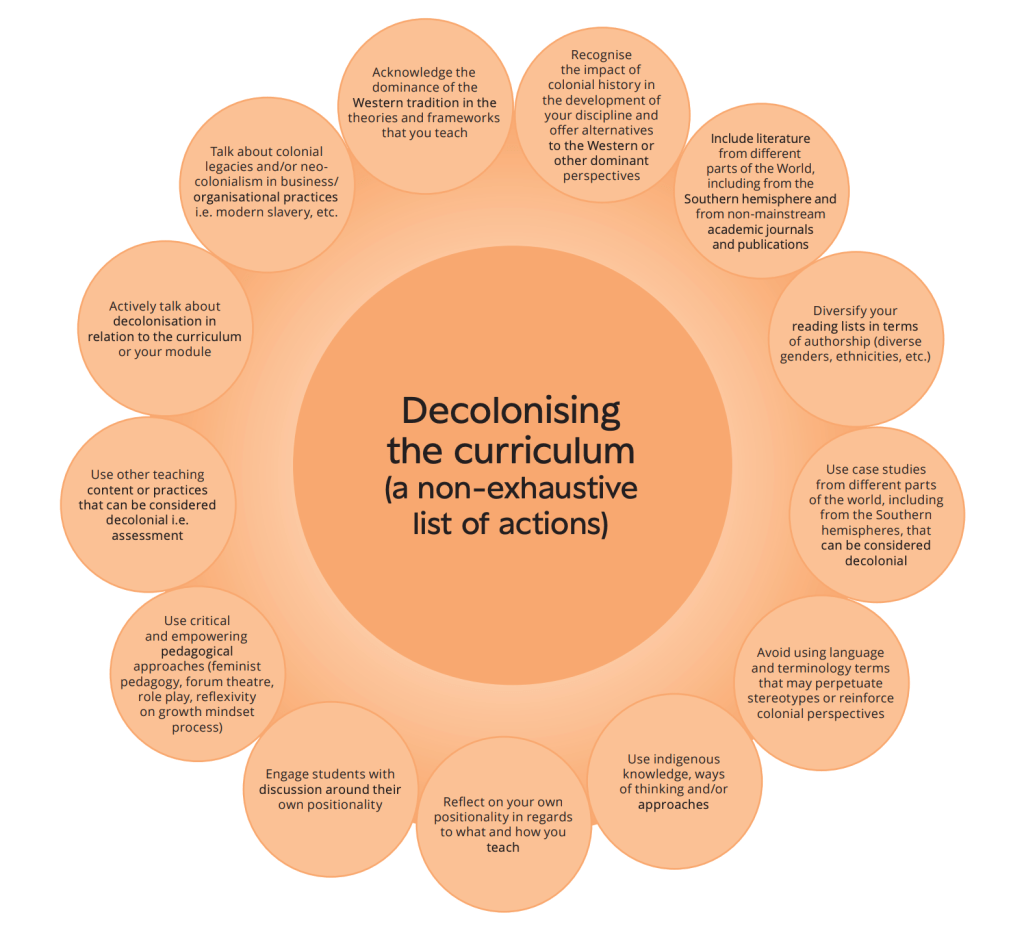
The below non-exhaustive list of actions to decolonising the curriculum, taken from the ‘Decolonising a business school in context: from theory to practice’ case report, published by Sage, 2025
Recommended steps
Step 1: Understanding / learning about the topic and existing practices
- Start by engaging with the decolonisation literature in general, in your discipline, including examples of practice to decolonise the curriculum
- Be strategic: What interests and excites you? How does it fit with your research, teaching, etc.?
- Focus on some areas as a starting point – see above framework
- Take into account and link with the school context and environment: the project research, other colleagues’ research and your own research
- Talk with those who have expertise and knowledge in the school
- Is there something that you are interested in contributing to within your own School (e.g. a decolonialisation seminar series) or that you would like to organise as your own event or activity?
Step 2: Practising / co-creating with students and others
- Develop / embed new content into your module
- Rethink your pedagogy
- Work with students, professional services and other stakeholders or local partners
- Start small, pilot things on your module, and evaluate them
- Apply for seedcorn funding if helpful to develop new practices
- Have fun and be reflexive
Step 3: Sharing and disseminating with
others in the school and more widely
- Share your practice within your School or with others
- Blog about it and share what you do on social media
- Present at conferences and other external events
- Publish your work and contribute to academic literature and debate
Then the cycle starts again.
Balancing a bottom-up approach with embedding decolonisation of the curriculum within the formal processes and structure of the school
A central challenge for the project was to develop an organic, bottom-up approach to decolonising the curriculum while also embedding this work within the School’s formal structures and processes. The aim was to support sustainability and long-term change without reducing decolonisation to a procedural or tick-box exercise. To address this, we worked closely with colleagues in Education and Equity, Diversity and Belonging (EDB) roles, including through an away day that explored strategies for integrating decolonising principles into educational practices and EDB initiatives. This led to an agreed set of actions that could be taken forward through formal education and EDB committees. We also contributed to programme redesign meetings and workshops for the new MBA and Business Management programmes, where we explored how decolonisation could be embedded across core and optional modules as well as extracurricular activities. However, embedding decolonisation through formal channels has been challenging, as colleagues are already navigating multiple quality assurance processes, and this work can be perceived as an additional demand on time and resources. Progress has therefore depended, in part, on the willingness of individual staff to champion decolonisation and advocate for its importance within the School.
More information on decolonising the curriculum can be found within the introductory course where there are dedicated pages on decolonising the curriculum and pedagogies.
Explore our other project activities:
 Decolonising a Business School